
Skull cap circa 1500
One piece bowl cut out over the ears. Pierced with 2 small holes above each ear and one at the front and back. Painted with 57 inside. Brass tag stamped 650 attached to one side. The sketch shows how the shape of this skull cap relates to teh shape of an early 16th c. burgonet - item number A-270.
Provenance: From the George F. Harding Collection, previously ex collection Archduke Eugen - Fortress Hohenwerfen. Apparently lot 833 from the 1927 catalogue (page 144).
8 1/4in. long, 7in. wide, 4in. deep.
Thickness varies. Generally the thickest area is around the edge where there are some spots which reach .11in, on average closer to .095in. One inch in from the edge is is app. .090in (varying between .085 and .1). Two inches in it is app. .075 in, varying up to .085. Three inches in the thickness is generally .060-065in. Assuming the progression of thickness is indicative of the manufacture, it seems that the arches over the ears were likely cut from the completed form since the thickness is consistent with simlar distances from the main edge, not from the edge of the arch.
Not for sale.
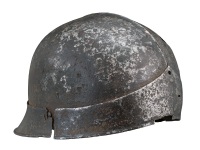
Sallet circa 1500-10
North Italian. Formed of a hemispherical skull rising to a low medial ridge with a brow and tail plate. The brow plate rises to a central point. The brow and tail plate have narrow inward turns on the bottom edge. Overall heavily pitted, chipped, and in places holed. The skull shows signs of hammer marks on the inside and a smoother finish on the outside. There are 8 rivets or holes which have lost the rivets that appear to have been used to secure the lining. The brow and tail plates secured by rivets on each end to the skull (the one on the right side of the tail lame broken out). Small brazed repairs, a working life riveted repair at the nape and a modern repair at the center of the tail. The type of helmet, form of the helmet, condition and repairs are consistent with pieces from the armoury of the Knights of St. John at Rhodes. For items from this source see The Medieval Armour From Rhodes - Karcheski and ,Richardson.
Measurements: 7 3/4 in. (19.8 cm) high, bowl 8 1/4 wide at the side and 10 1/4 long. 12 1/2 in. long overall between the center of the brow and the end of the tail. Brow and tail lame 1 3/4 in tall at the ends, brow 3 in. tall at the center point and tail 2 1/2 in. tall in the center.
Thickness (after significant corrosion): tail and brow plates vary between .020 and .050 inches, mostly .040-.050 in. the bowl varies between .035 and .070, mostly .046-.060 in. Thickness varies point to point as we usually see in these things.
Weight 3 pounds 0.8 ounces (1380 g).
Not for sale.

Sallet circa 1500-1510
Simple form, shaped to the head and with a short tail at the back for the neck. Low central crest. Excavated condition with signifant losses at the edges and one small detached piece on the left. One edge section appears to be re-attached with epoxy. The form of the helmet indicates that this is probably for use in the Iberian penninsula. There are a large number of these in the collection of the army museum in Toledo (the Museo del Ejercito in the Alcazar). These have a different form of crest. I have also found a similar (in better condition) piece in the Royal Armouries - IV.2056. This is described as having been found near the site of the battle of Castillon (1453), so the RA dates theirs to the mid 15th c.
Not for sale.

Skull Cap circa 1500-1520
Simple form, shaped to the head and with a narrow flare at the neck. This is basically a skull cap with a little bit of extension at the neck producing a very narrow tail. It is sort of the sallet flavor of a skull cap. Just to the right of the center line on the "tail" there is a partially stamped unidentified mark. There is a line of 10 holes for lining rivets around the base of the skull.
This type of helmet would have been used as part of an almain rivet or splint - a style of light armour produced in large numbers in the early 16th c. They are often associated with the landskenechts. Both Maximilian and Henry VIII ordered these in large numbers. There are very slight signs of delaminations, a flat spot in the left rear, a small creased dent just forward of the flat spot and a bend below a lining hole that may show signs of slight fracture. The last may indicate that the piece is hardened.
There is a nearly identical helmet illustrated in 2,500 Years of European Helmets by Howard Curtis on page 190 (identified as . 1500-1520 #212 in the author's collection).
Measurements: Thickness: generally in the range of .050 but with thicker spots .060-.065 near the right crown and consistently tapering to .035 near the tail. Thinning at the back seems to be the only intentional thinckness management. Weight: 1 pound 6.8 ounces (650g).
Not for sale.

Pikeman's pot early 17th c.
Typical two piece skull joined at a low turned comb and extended to form a downturned brim. Struck with a mark near the base of the brim on one side. I have described this as a crowned A mark of the London Armourer's Company. With additional photographs I don't think that it has the typical form for this mark. It may be a W over some other letters, or letters and numbers. There appears to be a very small "H" or "R" in the middle of the mark. I do not see anything similar in "The London Armourers of the 17th Century." Base of skull and edge of brim with lines of rivets. Outer edge of brim with a plain inward turned roll and a parallel engraved line. Small riveted internal patch at the edge of the brim at the left rear. Overall pitted surface
Not for sale.

Lobster Tailed Pot circa 1640
A lobster tailed pot. Helmet bowl formed in one piece with raised lines radiating from the center. Articulated tail formed of 4 plates each with rolled outer edges. Secured at the sides by articulating rivets and with the remains of a central leather. 2 cheekplaces with rolled edges and central perforation. Brim fixed to the bowl. Sliding nasal secured by a turn-screw with large flattened head. The center of the bowl has a loop secured through a round washer. Leather strips for securing the lining remain around the tail, cheek plates and bowl. The helmet is marked with an M at the point of the brim on the outside and a broad V on the inside of the brim. The marks on the helmet resemble the marks used by the London Armourer's company, but the one piece form is more typical of the continent and is possibly of German manufacture.
Not for sale.

Lobster-tailed pot circa 1650
Deep, heavy bowl formed of 2 pieces joined at the center with a flat riveted seam. The seam is inset to that the outside is flush. There is an engraved/chiseled line on the other side of the seam to simulate a central band. The bowl is rough-from-the-hammer. Pointed, hinged fall with 3 bars covering the face. Tail of one piece simulating 3 lames. The outer border of the tail has an inward-turned roll and a parallel recessed border. Lining rivets around the front edge of the bowl and along the edge of the tail. Skull marked on one side near the bottom. This mark appears to be a crowned IR, relatively illegible. This appears to be normal - see The London Armourers of the 17th Century by Thom Richardson, page 19. Cheek plates missing. The 2 piece skull and 3 bar face are typical of English armour of the period.
Measurements: bowl 8 3/4 in. front to back, 6 3/4 in. side to side, 6 in. deep at the center, bars 6 1/2 in. from the base of the brim to the bottom of the point.
Thickness: Tail .040-.050 in., Brim mainly .040-.050 in. except at the corner and pivot area where it gets much thicker - app. .090 in. The bowl varies significantly in thickness. It is generally thinner at the bottom and thicker at the top. A sampling of measurements show .070, .150, .090. It is generally around .090-.120 but it varies significantly in a small area.
Not for sale.

Pikeman's Pot mid 17th c.
Of typical form. Two piece skull secured by a rolled seam on a short comb at the top of the skull and an overlap in the brim and base of the skull. Decorated with a double line of engraved lines above and below the rivets along the lower edge of the skull. There is a single engraved line paralleling the comb. Wide brim turned down slightly at the sides. Edge of the brim with a plain inward turned roll (over wire) and recessed border. Brim marked at the rear with a cross of St. George. This appears to be a government mark from the period of the Commonwealth. There is a line of rivets for lining strips along the base of the skull and at the edge of the brim. There is a plain iron plume holder riveted to the back of the skull. The body of the skull and brim are covered in relatively rough grind or file marks. The pattern indicates that they may be from the original "bright" finish. The brim with a some later holes. Likely covered in older varnish or other coating.
Not for sale.

Harquebusier's Pot mid 17th c.
Two piece bowl joined by a roll a the top of a short central crest. Single neck lame embossed to simulate several lames. Hinged fall with 3 bar face protection.
Not for sale.